In a country obsessed with batting records, centuries, and strike rates, the bowlers are often the unsung heroes. But any true cricket fan knows the adage: Batters win you matches, but bowlers win you tournaments. (Or in Test cricket, they win you the series).
Taking 100 wickets in Test cricket is no small feat. It requires fitness, consistency, and the ability to toil for days on unresponsive pitches. For an Indian bowler, it’s arguably even harder fighting against flat subcontinental tracks or adapting to foreign conditions where the ball behaves completely differently.
As of late 2025, the club of Indian bowlers with over 100 Test wickets has grown, welcoming modern greats who have redefined Indian fast bowling.
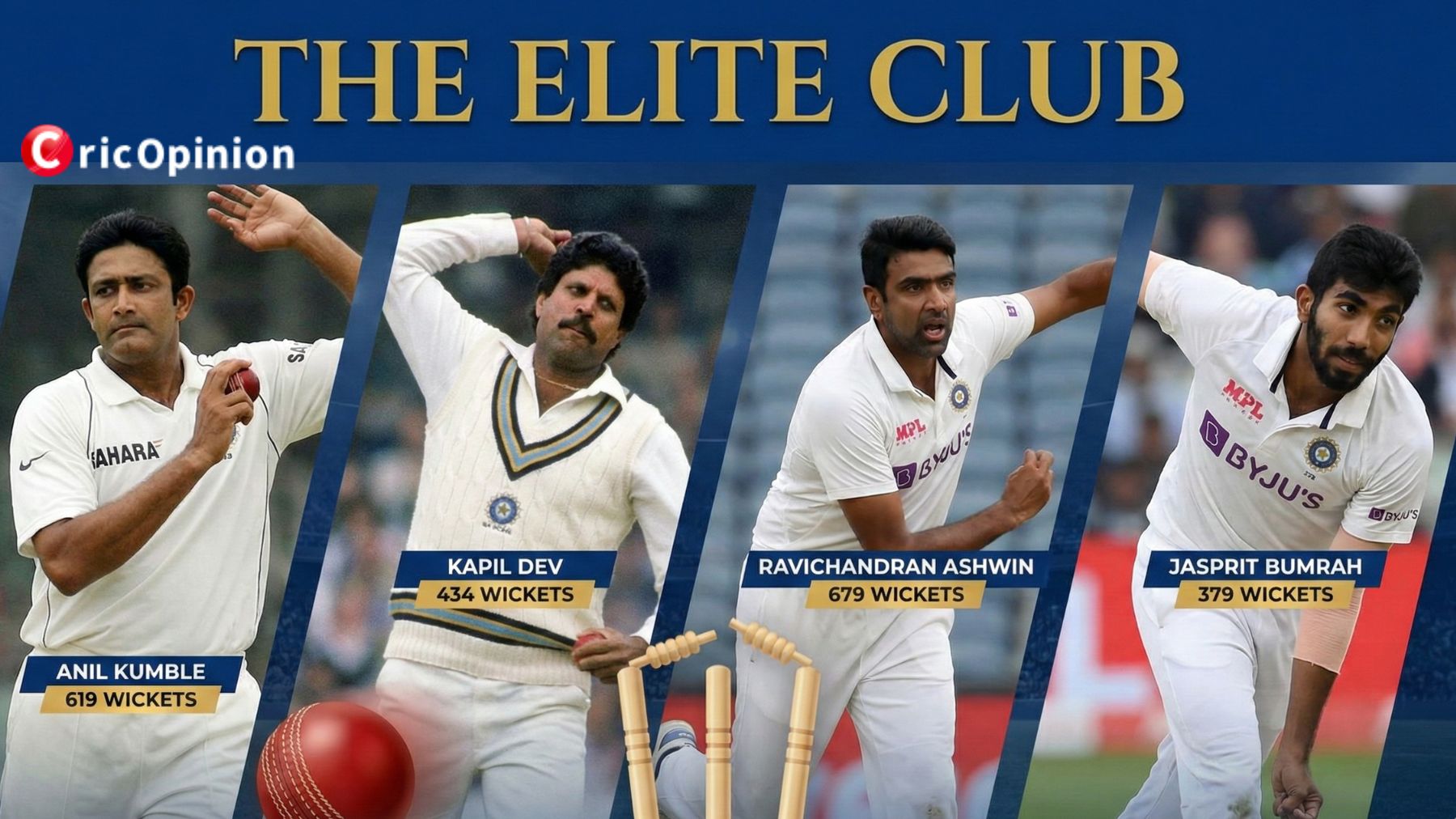
Here is a breakdown of the elite club, from the spin wizards of the 70s to the pace machines of today.
Only two men sit at this table. They are the giants of Indian bowling history.
The Jumbo Jet. For nearly two decades, Anil Kumble was the Indian bowling attack. He wasn't the biggest turner of the ball, but his accuracy, bounce, and fighting spirit were unmatched. Famous for bowling with a broken jaw in Antigua and taking all 10 wickets in an innings against Pakistan, Kumble remains the gold standard.
The Scientist Ashwin isn't just a bowler; he is a cricket computer constantly processing data. With a bag of tricks that includes the carrom ball, the slider, and subtle changes in flight, he has been India's biggest match-winner at home for over a decade. In 2024, he became only the second Indian to cross the 500-wicket mark, cementing his legacy as an all-time great.
The backbone of Indian cricket across different eras.
The Haryana Hurricane Before Bumrah or Shami, there was Kapil. For years, he carried the burden of Indian fast bowling alone on dustbowls meant for spinners. He held the world record for the most Test wickets for a considerable period after overtaking Richard Hadlee. His longevity and fitness were freakish—he hardly ever missed a match due to injury.
The Turbanator. Who can forget the 2001 series against Australia? A young Harbhajan Singh destroyed the mighty Aussies, including a hat-trick at Eden Gardens. He was the perfect aggressor to Kumble’s discipline, and his doosra was a nightmare for batters worldwide.
The Rockstar. Initially seen as a white-ball specialist, Jadeja transformed into a Test beast. He doesn't rely on mystery; he kills you with relentless accuracy. Bowling over after over on the same spot, he forces batters to make a mistake. He is currently one of the fastest in the world to reach the "300 wickets + 3000 runs" double.
The Workhorse Ishant’s career is a story of evolution. He started as a teenage sensation, went through a rough patch, and emerged as the leader of India’s pace renaissance under Virat Kohli. He is one of the few Indian fast bowlers to play 100 Test matches—a testament to his incredible fitness.
The Swing King Zaheer Khan was the master of reverse swing and the mentor for the current generation of pacers. His ability to move the old ball and outthink batters (like his dominance over Graeme Smith) made him invaluable, especially in overseas wins.
A mix of classic artistry and modern lethality.
Poetry in motion. Bedi didn’t just bowl; he teased batters with flight and loop. He was the leader of the famous spin quartet and remains one of the most excellent left-arm spinners the game has ever seen.
A polio attack in childhood left his right arm withered, but Chandra turned it into his greatest weapon. He bowled erratic, quick leg-spin that was impossible to read. He was India’s biggest match-winner overseas in the 70s.
The bridge between Kapil Dev and Zaheer Khan. Srinath was genuinely quick and carried the Indian pace attack through the 90s, often without much support at the other end.
The Phenomenon. In just over 50 Tests, Bumrah has rocketed up this list. With his unorthodox action and lethal yorkers, he is arguably the most complete fast bowler India has ever produced. He recently became the fastest Indian pacer to reach 150 and 200 Test wickets, and his average is unrivalled in the modern game.
If the seam position were an art form, Shami would be Picasso. When he finds his rhythm, he is unplayable. A key architect of India’s dominance in the World Test Championship era, Shami’s second-innings spells are legendary.
The players who played crucial supporting roles or had brilliant but shorter peaks.




More Links








 FANTASY CRICKET TIPS