There is an old cricketing adage that holds truer than any other: "Catches win matches." While towering sixes and rattling stumps grab the headlines, the course of a match is often turned by a moment of brilliance in the field, a sharp reflex catch at silly point, a diving effort at backward point, or the unwavering concentration required in the slip cordon.
For decades, Indian cricket was defined by sublime wristy batting and wily spin bowling. Fielding was often seen as an afterthought, something to be endured between batting stints. However, the narrative has shifted dramatically over the last 30 years. From individual brilliance in the 90s to the fitness revolution led by the modern generation, India has transformed into one of the world's paramount fielding sides.
This article details the Indian players with the safest hands in history, the titans who hold the record for the most catches in combined international cricket.
Before diving into the list, a vital distinction must be made. In cricketing statistics, catches taken by wicketkeepers are categorized differently from those taken by outfield players.
If we were to include wicketkeepers, MS Dhoni would top this list by a colossal margin, having taken 634 catches behind the stumps across formats.
However, when cricket fans ask, "Who has the most catches?", they are almost always referring to outfield players. Therefore, this list focuses exclusively on non-wicketkeeping fielders: the slip merchants, the cover drivers, and the boundary riders.
Here are the highest catch-takers in Indian cricket history across Tests, ODIs, and T20Is combined.
Total International Catches: 334(Tests: 210 | ODIs: 124 | T20Is: 0)
Rahul Dravid was not just the backbone of India's batting; he was the anchor of its slip cordon. Topping this list by a significant margin, Dravid's contribution to Indian cricket's golden era of spin was immeasurable.
Dravid holds the world record for the most catches in Test cricket history by a non-wicketkeeper (210). His success was built on immense powers of concentration, soft hands that absorbed the pace of the ball, and incredible reflex reactions. Standing at first slip to Anil Kumble and Harbhajan Singh on turning subcontinental tracks required nerves of steel, and Dravid rarely faltered. His partnership in the slips with VVS Laxman is legendary.
Total International Catches: 320+ (Active Player)(Approx. breakdown: Tests: 115+ | ODIs: 155+ | T20Is: 50+)
Note: Stats are approximate as of late 2025 and subject to change as he is an active player.
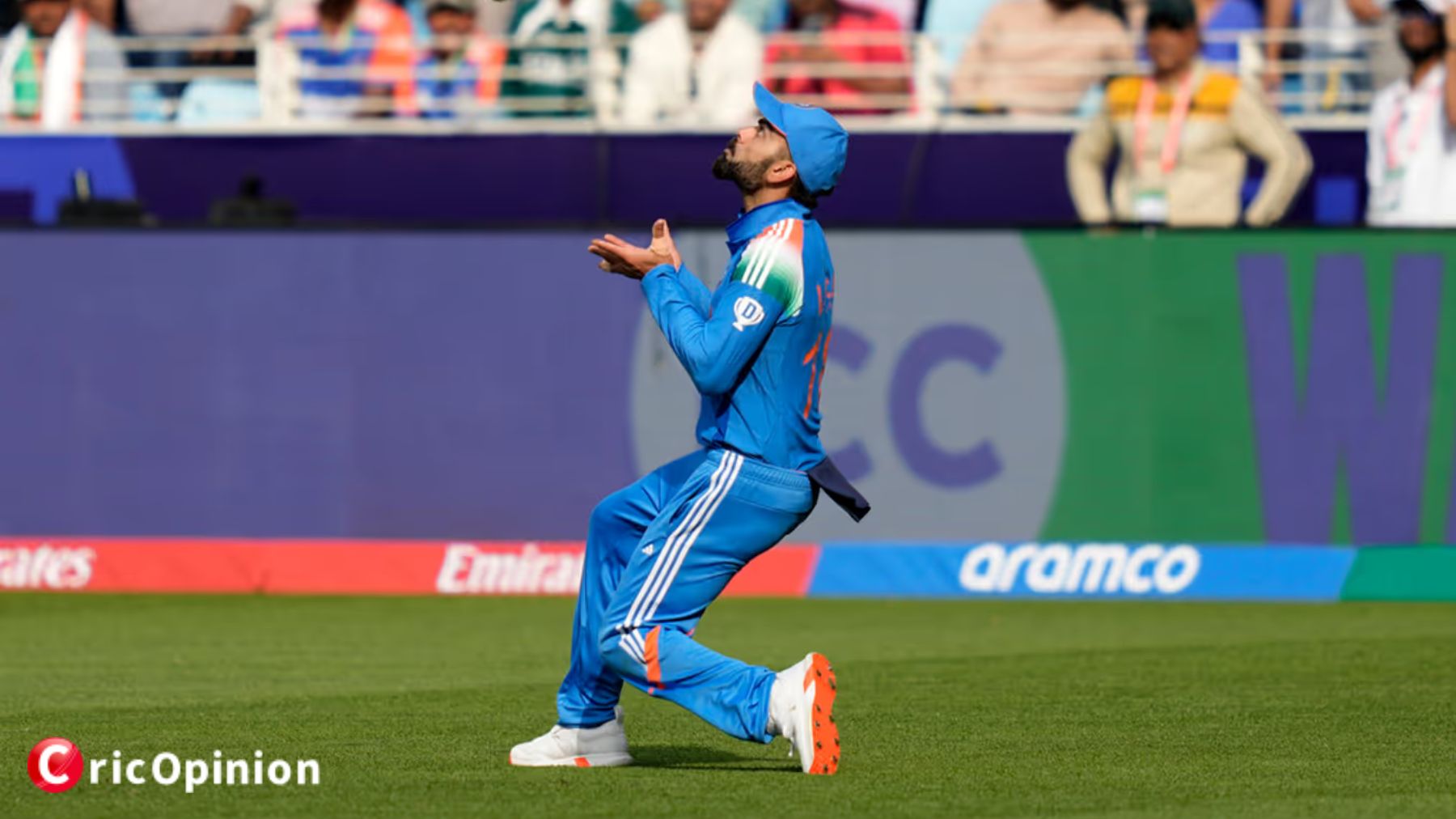
Hot on Dravid's heels is the icon of modern Indian cricket fitness, Virat Kohli. Kohli represents the evolution of the Indian fielder. Unlike Dravid, who specialized in the slips, Kohli is a multi-dimensional fielder.
Early in his career, he was a dynamo inside the ring at cover or backward point, cutting off singles with aggression. In the latter stages of his career, he has transitioned beautifully into a reliable slip fielder, particularly against fast bowlers. Kohli’s catch tally is a testament to his high energy levels, his desire to always be involved in the game, and the sheer volume of cricket played across three formats in the modern era.
Total International Catches: 256(Tests: 115 | ODIs: 140 | T20Is: 1)
It seems no batting or longevity list in Indian cricket does not feature Sachin Tendulkar near the top. His presence at number three is largely due to the sheer length of his career—24 years at the highest level.
However, to dismiss Tendulkar as merely an accumulator would be unfair. In his youth, he was a tremendous outfielder with a bullet arm. As he aged, he moved into the slip cordon, providing a safe pair of hands. His ability to read the game as a batsman often helped his anticipation as a fielder.
Total International Catches: 261(Tests: 105 | ODIs: 156)
Before the fitness era, there was Mohammad Azharuddin. In the 1980s and early 90s, Azharuddin was an anomaly in Indian cricket, a fielder who could walk into any international side purely on his fielding merit.
Azhar maintained a languid grace in the field that mirrored his batting. He made the rugged look ridiculously easy. He patrolled the covers with a panther-like stride and possessed an unbelievably quick release. For a generation of Indian fans, Azhar was the first true definition of a world-class Indian fielder. His ODI catch count is particularly impressive for the era in which he played.
Total International Catches: 200+ (Active Player)
Often described as having "lazy elegance" in his batting, Rohit Sharma possesses the same trait in his fielding. He rarely looks rushed, yet he gets to the ball.
Rohit started as a sharp fielder inside the circle but has established himself as one of the safest slip fielders in the world against pace bowling. His reactions are underrated, and his ability to pouch low catches in the cordon has been vital for India's fast-bowling resurgence in Test cricket.
Total International Catches: 174(Tests: 135 | ODIs: 39)
VVS Laxman was a specialist. While not known for his athleticism in the outfield, put him at second or third, and nothing got past him.
Laxman possessed perhaps the softest pair of hands Indian cricket has ever seen. If Dravid was the concentration king at first slip, Laxman was the reflex master next to him. Their synchronized movements in the cordon were poetry in motion, accounting for hundreds of wickets for India’s bowlers.
Some players may not have the sheer volume of catches due to shorter careers or playing fewer Test matches, but their impact on Indian fielding culture was monumental.
Looking at this list, one can trace the evolution of Indian cricket. It moves from the individual artistic brilliance of Azharuddin, through the specialized concentration of the Dravid/Laxman era, to the modern athletic powerhouses led by Kohli and Rohit.
While Rahul Dravid remains the benchmark for slip catching, the modern demands of T20 cricket mean today's players must be versatile athletes. Yet, regardless of the era, the fundamental requirement remains the same: when the ball flies off the edge, India needs safe hands to secure the victory.




More Links








 FANTASY CRICKET TIPS