They say "Catches Win Matches," but that cliché doesn’t capture the sheer exhaustion of fielding in Test cricket.
Imagine standing in the slip cordon for 90 overs a day. Your legs are heavy, the sun is beating down, and you haven't touched the ball in three hours. Then, in a split second, a thick edge flies off the bat at 140 km/h. You have less than 0.5 seconds to react.
If you drop it, the bowler hates you, the crowd groans, and the batsman might go on to score a hundred. If you catch it, you’re just doing your job.
In the history of Test cricket, only a handful of players have turned this thankless job into an art form. These are the men with the safest hands the game has ever seen.
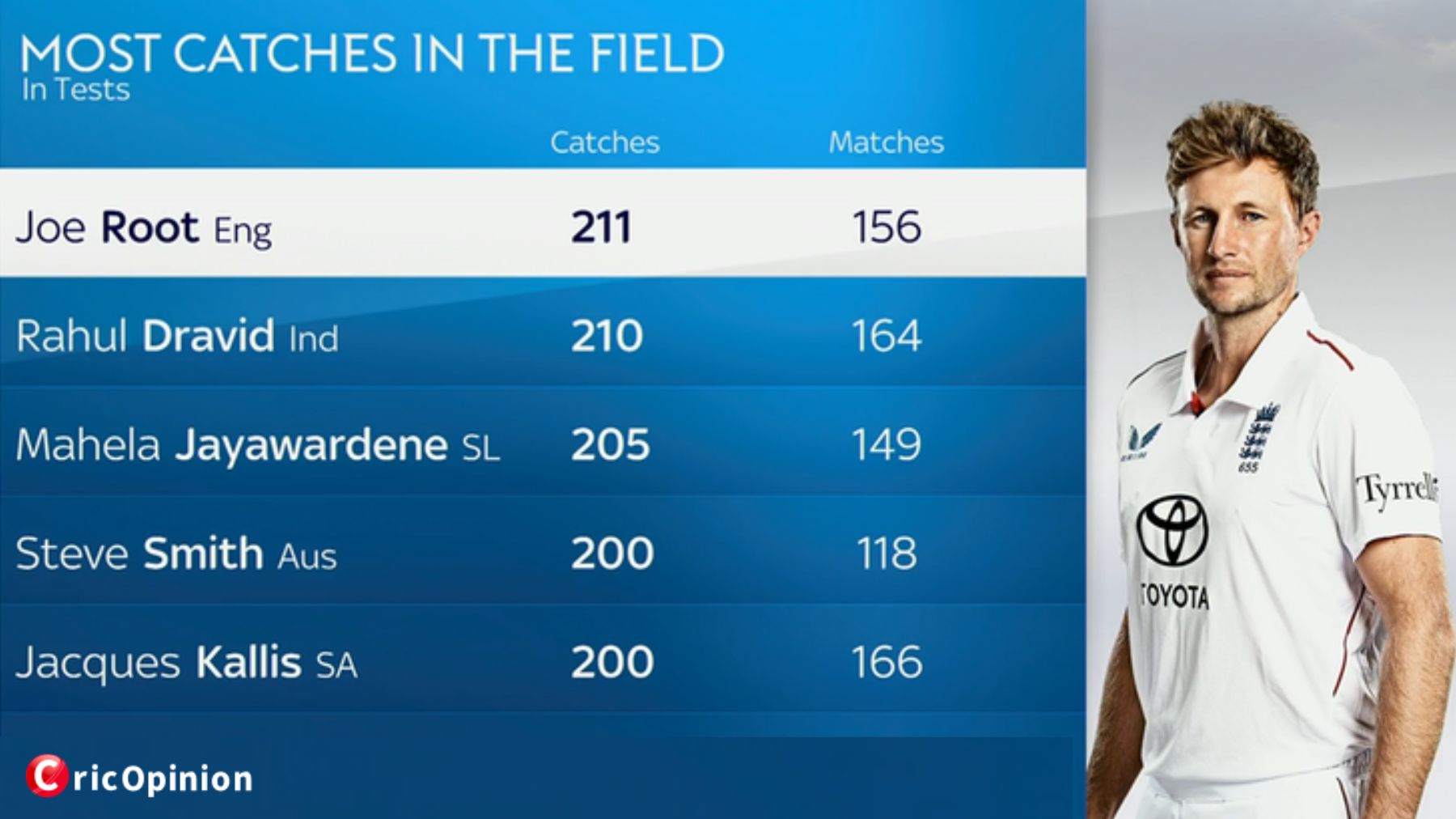
In July 2025, during a heated Test at Lord's against India, Joe Root did what seemed inevitable: he flew to his left, plucked a one-handed screamer, and officially surpassed "The Wall" to become the most excellent catcher in Test history.
His batting often overshadows Root’s brilliance, but his fielding statistics are frighteningly consistent. For over a decade, he was the silent partner to James Anderson and Stuart Broad. When you have bowlers who find the edge that often, you need a slip fielder who doesn't sleep.
The "Human" Factor: Root doesn't have the rigid, intense stance of some older players. He stands with a slight crouch, often smiling, looking like he's enjoying a Sunday game. But his "soft hands" technique is textbook. He doesn't snatch at the ball; he lets it come to him, absorbing the pace like a sponge.
For years, the record belonged to one man. Rahul Dravid wasn't just a defensive genius with the bat; he was a vacuum cleaner in the slip cordon.
Dravid’s fielding numbers are mind-boggling when you realize he spent most of his career fielding to spinners. Standing in the slips for Anil Kumble and Harbhajan Singh is a different kind of nightmare compared to fast bowling. You have to stand closer; the reaction time is shorter, and the ball dips and turns unpredictably.
The Signature Move: Dravid famously wore a white sun hat, pulling the brim low. He barely moved. He barely spoke. But when the ball flew off the edge, his hands were always in the right place. He holds the world record for the most catches by a non-wicketkeeper for a reason: he simply didn't make mistakes.
If Dravid was the master of concentration, Mahela was the master of instinct. He played in an era where Muttiah Muralitharan was taking 800 wickets, and Mahela was the man catching a massive chunk of them.
The "c Jayawardene b Muralitharan" Connection: This is the most common dismissal summary in the history of cricket. They combined for 77 wickets, a record for a fielder/bowler duo. Mahela fielded at first slip to Murali, a position that requires reading the doosra from the hand. If he didn't know which way the ball was spinning, he would have broken his fingers. He never did.
Jacques Kallis was a giant of a man with broad shoulders, yet he caught the ball with the delicacy of a pianist. He recently reached the 200-catch club, cementing his status as perhaps the greatest all-round cricketer ever (Batting + Bowling + Fielding).
Kallis usually stood at Second Slip. This is a tricky spot you have to dive across to First Slip or react to thick edges flying wide to your right. Because of his size, Kallis didn't need to dive as much; his reach was enormous. If the ball was in his postcode, it stuck.
Steve Smith is the only other active player on this list chasing down history. In early 2025, he took a flurry of catches in the Sri Lanka series to storm past Ricky Ponting (196 catches).
Smith is not a traditional slip fielder. He stands wider, he fidgets, and he sometimes anticipates the shot before the batter has even played it. While he is famous for his slip catching, Smith is also a demon at "Leg Slip," a terrifying position where the ball is smashed at you from close range.
You might look at these stats and think, "It's just catching." But consider this: A dropped catch costs an average of 40 runs in Test cricket.
These players aren't on this list because they were flashy. They are on this list because they were reliable. In a game that lasts five days, reliability is the most valuable currency of all.




More Links








 FANTASY CRICKET TIPS